A fireplace has always been a natural gathering point in the home. It's the kind of feature that shapes how a room feels as much as how it looks. In a small living room, the challenge isn't whether you can have one, it's choosing the right type and making it work with the space you have. Get the combination of fireplace, layout, and styling right, and a compact room can feel warmer, more characterful, and more liveable than many larger ones.
This guide covers everything you need to know about choosing a fireplace for your small living room, including types, styles, layout ideas, safety considerations, and more.
Contents
The best fireplace types for small living rooms
Styles that work well with smaller fireplaces
Layout and placement ideas
How to make a fireplace the focal point in a small room
Safety and ventilation considerations
Space-saving tips
Small bedroom fireplace ideas
The best fireplace types for small living rooms
Before you start thinking about finishes and features, it's worth deciding which type of fire is the best fit for your room. Not every fireplace works in a compact space, and some are far more practical than others when square footage is limited.
Inset electric fires
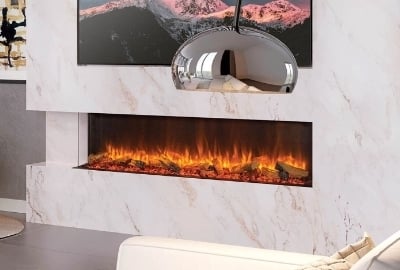
Inset electric fires are one of the best options for small living rooms because they sit flush within the wall, taking up no floor or shelf space at all. They work with or without an existing chimney breast and don't require any flue or ventilation work, which significantly reduces installation complexity in a tight space. The flame effect technology in modern inset fires has improved considerably, with many models producing a convincing, layered flame that's difficult to distinguish from a real fire at a glance.
Wall-mounted electric fires
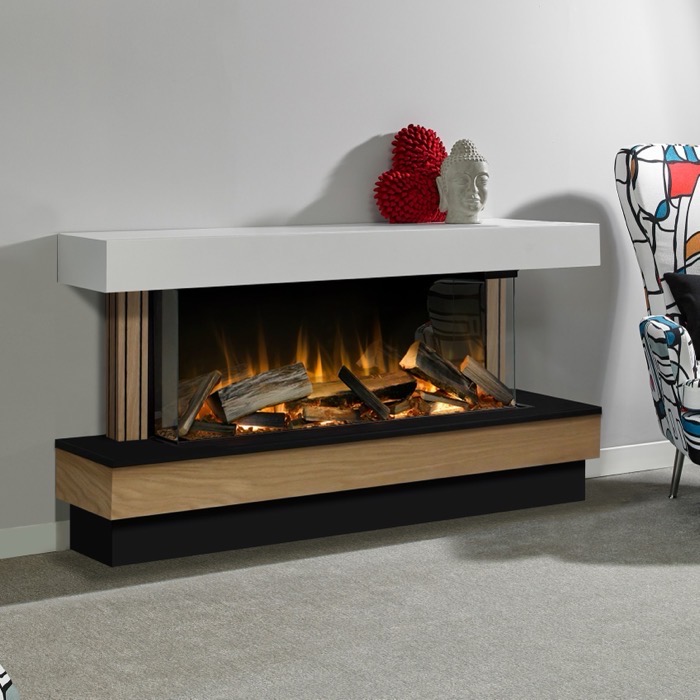
A wall-mounted electric fire projects slightly from the wall rather than sitting inside it, but it still has a very small footprint and keeps the floor completely clear. Mounting at eye level can work well in a small room where you want the fire at the centre of your sightline without a mantel or surround adding bulk. These tend to suit contemporary or minimalist interiors particularly well. They're also a practical option for rented properties, since most plug directly into a standard socket.
Flueless and balanced flue gas fires
For those who want the look and warmth of a real gas flame without the need for a traditional chimney, flueless gas fires are worth considering. They use a catalytic converter to clean the exhaust, meaning they can be installed in rooms without a flue — though they do require adequate ventilation (see the safety section below).
Balanced flue gas fires are another alternative: they draw air from outside through a sealed system, making them suitable for rooms where creating ventilation openings in the room itself isn't desirable. Both types give you a genuine gas flame in a comparatively compact format.
Inset gas fires
If your small living room has an existing chimney or a built-in recess, an inset gas fire can be a neat, proportionate solution. Like inset electric fires, these sit within the wall or fireplace opening and keep the surrounding area clean and uncluttered. A slimline or hole-in-the-wall gas fire in particular can look very well suited to a small room, creating a strong visual feature without the bulk of a full surround.
Styles that work well with smaller fireplaces
The overall interior style of the room has a significant effect on how a fireplace reads in a small space. Some styles are far more forgiving of compact rooms than others.
Scandinavian and minimalist
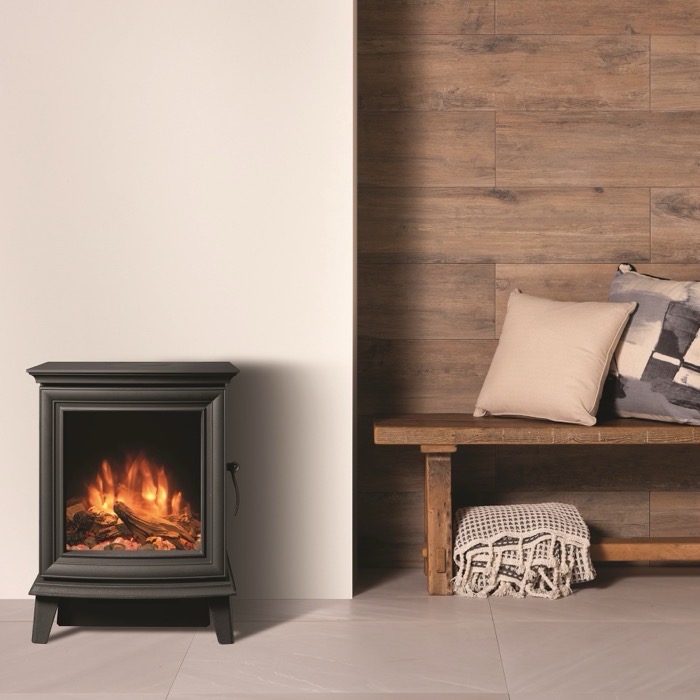
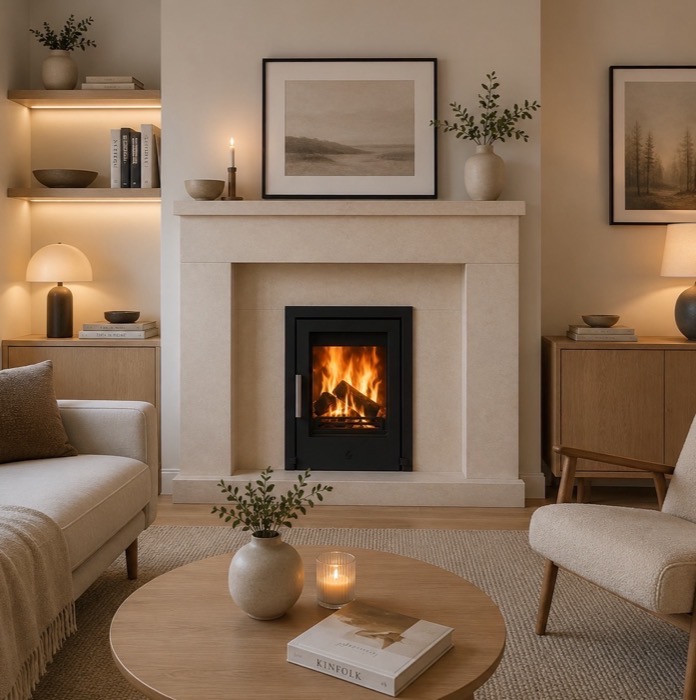
Scandi-inspired interiors are arguably the most naturally suited to small fireplaces. The emphasis on simplicity, pale tones, natural materials, and deliberate minimalism means that a compact fire with a simple surround, or even no surround at all, fits cleanly into the scheme.
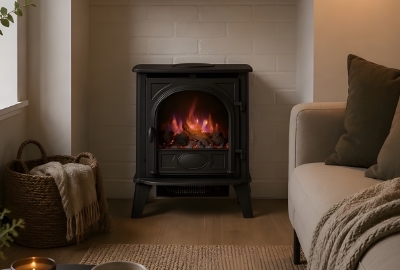
A stove or flush inset fire with a slim black or brushed steel frame against a white or light grey wall, paired with a wooden floor and carefully chosen accessories, can look intentional rather than sparse. The lack of ornamentation around the fire also keeps the room feeling open.
Modern and contemporary
Contemporary styles suit the clean lines of hole-in-the-wall and wall-mounted fires particularly well. In a small room, a single-plane electric or gas fire with no visible frame can create a striking feature without adding visual weight. Pairing it with a media wall arrangement, where the TV sits above or alongside the fire, is a popular approach in modern interiors and one that works well in compact rooms because it consolidates the main visual elements of the room into a single zone.
Rustic and country
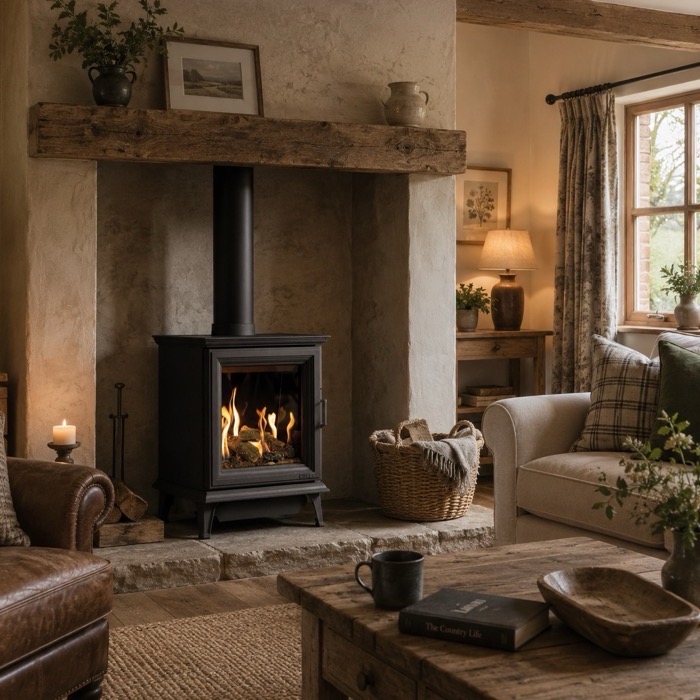
A rustic aesthetic can work well in a small living room as long as the proportions of the fireplace are right. An ornate Victorian cast iron surround or a deep inglenook may overpower a tiny room, but a smaller traditional surround in painted wood or limestone, with a simple grate or log-effect gas fire inside, can add real character without overwhelming the space. The key is keeping the mantel shelf relatively clean and limiting the number of decorative items on it.
Victorian and period
Many small living rooms in the UK are found in terraced houses and Victorian properties, where the original fireplace opening, chimney breast, and alcoves are already part of the architecture. In these rooms, restoring or working with the existing period character often gives the best results.
A cast iron combination fireplace, a small tiled surround, or a reclaimed mantel can complement the room's proportions naturally. For rooms with surviving original fireplaces, a gas or electric insert can be fitted into the existing opening to create a working fire without disturbing the period character.
Layout and placement ideas
Layout is where small living rooms with fireplaces can go wrong most easily. The position of the fire relative to seating, windows, and the TV needs to be thought through before anything is installed.
Use the chimney breast wall as the anchor
In most small living rooms, the fireplace belongs on the primary wall opposite the main seating. This is the most natural arrangement and means furniture faces the fire rather than being positioned at an awkward angle to it. If the chimney breast has alcoves on either side, these can be used for shelving or storage, which avoids wasting the flanking space and helps the fireplace feel embedded in the room rather than sitting in isolation.
Consider a corner placement
Placing a fire in a corner can free up wall space and work with an otherwise awkward room shape. The furniture arrangement does need a little more thought: angling a sofa or armchair slightly towards the corner, rather than setting everything parallel to the walls, will help the fire stay the visual centre of the room. A small rug positioned in front of the fire can also help to anchor the seating zone and define the arrangement.
TV placement in a small living room with a fireplace
One of the most commonly asked questions for small living rooms is where to put the TV when there's also a fireplace. The most common solution, and one that works well in compact rooms, is to mount the TV above the fireplace or directly within a shared media wall. This creates a single focal point on one wall, which is particularly useful when the room doesn't have the space for two separate feature walls.
If you go this route, it's worth considering the viewing height. A TV mounted at a comfortable seated eye level usually works better ergonomically than one positioned very high on the wall above a mantel. Inset fires and lower-profile electric fires make it easier to keep the TV at an appropriate height, as there's less vertical distance consumed by the fireplace itself. For more on this topic, our guide to mounting a TV above a fireplace covers the practical considerations in detail.
Bay window rooms
A small living room with a bay window and a fireplace presents a specific layout challenge, since both features naturally draw the eye. The most effective approach is usually to keep the fireplace as the primary seating focal point and treat the bay as a secondary zone, perhaps with a small chair or reading nook rather than the main sofa.
How to make a fireplace the focal point in a small room
In a large room, a fireplace has to work harder to dominate because there's more competing for attention. In a small room, the opposite is true: even a modest fire can become the undisputed centrepiece if the surrounding styling is handled well.
Keep the surround in proportion
One of the most common mistakes in small rooms is choosing a surround that's too large for the space. A mantel that extends high up the wall or a wide surround with deep shelves can make a small room feel crowded and leave little visual breathing room. A compact surround, or no surround at all for inset fires, tends to look better in tight spaces. If you do want a mantel shelf, keeping it relatively plain, decorated with one or two items rather than a full arrangement, helps the fireplace itself remain the focus.
Use a mirror above the fire
Placing a mirror above a fireplace in a small room serves two purposes: it reflects light back into the space, making the room feel larger and brighter, and it acts as a decorative anchor above the fire without adding visual weight in the way that artwork can. A simple, frameless mirror or one with a thin metal frame tends to work better in small rooms than an ornate, chunky-framed version.
Use colour and contrast thoughtfully
A fireplace will naturally draw the eye if the wall it sits on is a different tone from the rest of the room. In a small space, a single accent wall behind the fire in a deeper or more textured finish, such as a dark paint colour, exposed brick, or a simple tile panel, can frame the fire without the room feeling oppressive.
Alternatively, colour drenching — painting the walls, ceiling, and woodwork all in the same shade — is a technique that can make a fireplace feel more integrated rather than dominant, which works well when the fire itself has a strong, simple design.
Keep the hearth and surround area clear
Clutter around the fireplace in a small room will quickly make the space feel cramped. A clean hearth with a small stack of logs or a single fireside accessory keeps the eye moving to the fire rather than stopping at the items around it. If your fire type requires a hearth, choosing a simple, flush stone or slate design rather than a raised or decorated platform will also help the fireplace feel less physically intrusive.
Safety and ventilation considerations
Before choosing and installing a fireplace in a small room, it's important to understand the safety and ventilation requirements that apply to different fire types. These aren't optional extras and in many cases they're legal requirements.
Ventilation requirements for gas fires
Gas fires require adequate ventilation in the room where they're installed. The specific requirements depend on the type of fire:
- Open-flued gas fires need a direct air supply from outside, usually via a purpose-built vent in the wall or floor, and must not be installed in a room that has been heavily sealed for draught-proofing.
- Flueless gas fires similarly require a minimum room volume and ventilation provision, and are subject to restrictions on room size. You'll usually find this information in the product description of your chosen fire.
- Balanced flue gas fires draw their combustion air from outside, so they are generally easier to accommodate in small, well-insulated rooms.
In a small living room, it's essential to have the ventilation requirements assessed by a Gas Safe registered engineer before purchasing a flueless model, since a room that is too small or too airtight may not be suitable.
Clearance distances
All fireplaces, including electric and gas models, require minimum clearance distances from furniture, soft furnishings, and combustible materials. For solid fuel and gas fires, these clearances are specified by the manufacturer and must be followed. In a small room, this means carefully measuring not just the fireplace footprint but the required clear zone in front of and around it before confirming whether a given model will work in the space. Electric fires typically require smaller clearances than gas or solid fuel options, which is another reason they are often the most practical choice for compact rooms.
Carbon monoxide detectors
Any room with a gas fire or solid fuel appliance should have a working carbon monoxide detector fitted, in line with building regulations. Carbon monoxide is odourless and invisible, making a detector essential rather than optional. For further guidance, we have a detailed guide on the importance of a carbon monoxide detector.
Professional installation
Gas fires must be installed by a Gas Safe registered engineer. Electric fires can often be self-installed if no additional wiring is required, but it's always worth seeking professional advice if you're installing into an existing chimney breast or making changes to the wall. For guidance on who should carry out installation work, see our guide to who should install your stove or fire.
Space-saving tips for small rooms with fireplaces
Use the alcoves for storage
If your fireplace sits on a chimney breast with alcoves on either side, these are natural candidates for built-in storage. Floor-to-ceiling shelving in the alcoves keeps books, media equipment, and decorative items off the floor and out of the main living area, while also framing the fireplace and helping it feel like the centrepiece of a deliberate composition rather than just a feature on a wall.
Consider a stove with integrated log storage
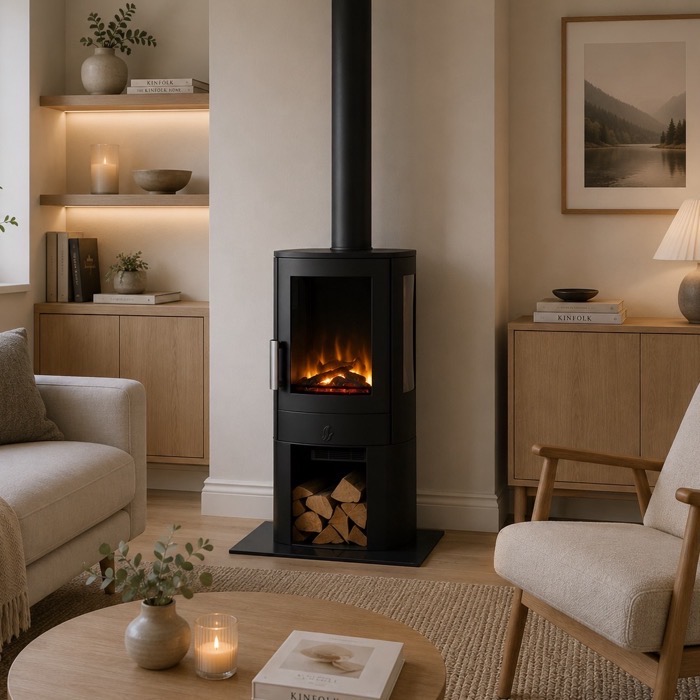
Some wood-burning stoves are designed with a built-in log store beneath the firebox. In a small room, this is a useful feature because it removes the need for a separate log basket or external log storage, keeping the area around the fire tidier. These log store stoves essentially serve two purposes in the same footprint.
Note that wood-burning stoves require a suitable flue or liner, so this option is primarily relevant for rooms with an existing chimney.
Opt for a media wall with an integrated fire
In small modern living rooms where both a TV and a fireplace are wanted, a media wall that incorporates both into a single built-in unit is often the most space-efficient solution. The TV, fire, and any storage for media equipment all occupy one wall, leaving the rest of the room free. This approach works particularly well with inset or hole-in-the-wall electric and gas fires, which sit cleanly within the structure. You can read more about creating a media wall in our guide to media wall ideas for every space.
Choose a proportionate surround
If you want a fireplace surround rather than a flush inset fire, choosing one scaled to the room will make a significant difference to how generous the space feels. Standard fireplace surrounds in the UK typically measure between 48 and 55 inches wide, but compact surrounds are available from around 30 or 40 inches. At that width, the surround takes up noticeably less wall space and leaves more room for the furniture arrangements on either side. The fire, surround, and hearth should all be selected as a proportionate set rather than individually, to avoid any element looking oversized relative to the others.
Small bedroom fireplace ideas
Bedroom fireplaces are most commonly found in Victorian and Edwardian terraced houses, where original cast iron combination fireplaces were installed as standard in most rooms. For those with an original bedroom fireplace, the question is usually whether to restore it or work around it. For those without one, bedroom fireplaces in small rooms are still achievable with the right type of fire.
Victorian bedroom fireplaces
Victorian cast iron combination fireplaces were designed specifically for bedrooms. They're compact, self-contained (combining the fire, back panel, and surround in a single piece), and proportioned for smaller rooms. If yours is still in place but no longer working, it can often be restored and fitted with a gas or electric insert, which brings it back into use without requiring a major rebuild. Even purely decorative, an original cast iron fireplace adds significant character to a small bedroom and works as a natural focal point for the room.
Electric fires in small bedrooms
For bedrooms without an existing fireplace, a compact wall-mounted or inset electric fire is the most practical choice. Electric fires require no flue or ventilation work and produce no combustion products, making them safe for use in bedrooms where ventilation is often more limited than in living rooms. A small hearth-mounted electric fire or a compact electric fire suite can add warmth and atmosphere to a bedroom without the installation requirements of a gas fire.
Gas fires in bedrooms
Gas fires can be installed in bedrooms, but the ventilation requirements are more stringent than in living rooms, given the typically smaller room volume and the fact that people sleep there. A balanced flue gas fire, which draws combustion air from outside rather than the room, is generally the safest option for a bedroom installation. Any gas fire in a bedroom must be installed by a Gas Safe registered engineer and will require an appropriate ventilation assessment.
Styling a small bedroom fireplace
In a small bedroom, the fireplace works best when the area around it is kept simple. A single piece of artwork, a small vase, or a mirror above the fire is usually enough. Over-decorating the mantel shelf in a bedroom can make the room feel busier rather than more personal. The fire should act as a point of warmth and interest, not a display surface. If the bedroom has limited storage, using the alcoves on either side of a chimney breast for fitted wardrobes is a practical way to make the most of the space.
A fireplace can make a small room feel far more characterful and liveable, whatever the style of the space or the size of the wall you're working with. The key is choosing a type of fire that suits the room's practical constraints, keeping the surrounding area well-proportioned, and treating the fire as the starting point for the room's layout rather than an afterthought.
Explore StovesAreUs's full range of electric fires, gas fires, and fireplaces to find the right option for your space. With over 20 years of experience, an Excellent Trustpilot rating from more than 6,000 reviews, and free delivery on orders over £100, we're here to help you make the right choice with confidence.